July 17, 2026
By Morrison
Abstract
This paper examines the critical tension between performative administrative inclusion and structural marginalization within state-level vocational rehabilitation and human services frameworks. While some state agencies have integrated blind and deaf leadership at the direct bureau level, the overarching state apparatus remains structured around non-disabled executive umbrella oversight and single-sensory paradigms rooted with biases. By prioritizing ocularcentric (sighted) and audist (hearing) administrative designs, state frameworks relegate the DeafBlind community to institutional gaps. This paper argues that the lack of authentic, dual-sensory representation in executive leadership, combined with a reliance on inadequate, and antiquated non-direct communication models, inflicts systemic violence. We analyze how these structural failures hollow out the civil rights promises of the Americans with Disabilities Act (ADA) and Disability Pride Month. With this, will justify the need for an establishment of self-determined, autonomous spaces governed entirely by and for the DeafBlind community.
Introduction: Performative Pride vs. Executive Exclusion
Every July, academic institutions, state agencies, and corporate entities flood public forums with proclamations celebrating Disability Pride Month and the anniversary of the Americans with Disabilities Act (ADA). These celebrations are heavily decorated with progressive rhetoric, highlighting commitments to accessibility, inclusion, and civil rights. Yet, when the leadership structures of these very institutions are examined, a stark and harmful reality is exposed: the systemic exclusion of DeafBlind individuals from top-tier executive roles.
The ADA was drafted to dismantle paternalistic systems and codify the right to self-determination. Disability Pride was born as a radical rejection of shame, asserting that disabled people are experts in their own lives and fully capable of self-governance. However, when non-disabled, hearing, and sighted administrators occupy the ultimate decision-making seats, governing communities they do not represent and whose lived experiences they do not share, Disability Pride Month and the ADA cease to be tools of liberation. Instead, they are co-opted as performative shields to protect the institutional status quo from genuine accountability.
1. Case Study: The Glass Ceiling at the Helen Keller National Center (HKNC)
The systemic hypocrisy of performative allyship is perfectly illustrated by the administrative crisis at the Helen Keller National Center (HKNC). In July 2024, the center appointed a white hearing, sighted man to serve as its Executive Director, bypassing highly qualified DeafBlind candidates. This decision sparked immediate, widespread community mobilization under the DeafBlind Leadership NOW (DBLN) movement. The appointment laid bare the deep-seated institutional biases that corrupt Disability Pride: To celebrate the legacy of Helen Keller and the progress of the ADA, while simultaneously declaring that a DeafBlind professional is unqualified to lead the premier national center dedicated to their own community, is the definition of performative inclusion.
This hiring decision sends a damaging message to the public and the community: we will celebrate you, we will study you, and we will fundraise off of you, but we do not trust you to lead. By prioritizing administrative credentials defined by sighted and hearing metrics over the irreplaceable expertise of lived DeafBlind experience, institutions keep the community in a permanent state of wardship, where non-disabled professionals are positioned as the administrators of their lives (DeafBlind Leadership NOW, 2024).
2. The Multi-Layered Ceiling: Single-Sensory Bureaucracy and Non-Disabled Oversight
On the state level, a more nuanced but equally restrictive power dynamic exists. In certain states (such as Massachusetts), direct services for the blind have made meaningful strides by appointing blind individuals to manage direct agency operations. However, systemic failure persists because of two higher administrative layers: non-disabled executive umbrella oversight and the inherent limitations of single-sensory frameworks.
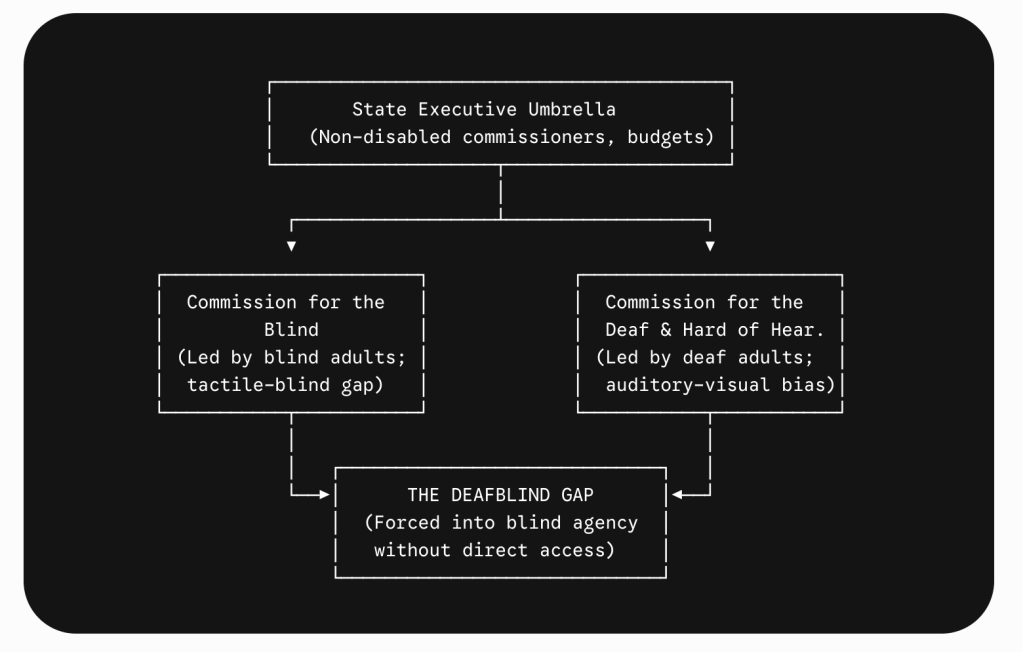
Image Description: top down chart with “State Executive Umbrella (Non-disabled commissioners, budgets)” on the top, below this has two seperate entity: “Commission for the Blind (led by blind adults; tactile-blind gap) and “Commision for the Deaf and Hard of Hearing (led by deaf adults; auditory-visual bias)”; on the bottom, “The DeafBlind Gap (forced into blind agency without direct access)”
The Power Dynamics of Executive Umbrella Agencies
Direct service bureaus do not operate in a vacuum; they answer to massive state umbrella departments (such as Departments of Human Services or Aging and Disability Services). The executive commissioners, budget directors, and political appointees inhabiting these higher tiers of authority are overwhelmingly non-disabled.
These top-level administrators hold the ultimate power over macro-level budgeting, civil service hiring requirements, and overarching policy approvals. When executive leadership lacks any personal or deep foundational grounding in authentic disability equity, direct service bureaus are forced to constantly fight for resources from a parent agency that views accessibility as a compliance expense rather than an absolute human right.
The Monocular Focus of Single-Sensory Leadership
Even when a state Commission for the Blind is operated by an authentic blind administrator, the agency itself remains fundamentally structured around a single-sensory paradigm. A blind leader who does not share the linguistic, cultural, or tactile realities of the DeafBlind community faces institutional limitations when designing dual-sensory programming. The same goes for the state Commission for the Deaf and Hard of Hearing (CDHH). Because the agency’s primary mandate is blindness (or deafness within the CDHH), the unique cultural framework of the DeafBlind community and the absolute necessity of direct tactile communication, is continually treated as a sub-specialty or an accommodation workaround rather than a standalone right.
3. The “Two-Commission” Trap and Linguistic Erasure
Because there is rarely an autonomous, dedicated DeafBlind space or bureau, DeafBlind individuals are forced to navigate the massive gaps between two single-sensory silos: the Commission for the Blind and the Commission for the Deaf and Hard of Hearing. This structure causes direct harm through the denial of direct communication:
- The Inadequate Interpreter Fallback: When a DeafBlind individual is assigned to a Commission for the Blind, they are met with an agency that typically operates using spoken English or standard print/braille infrastructure. Because staff and administrators rarely know sign language, they rely on external, contract interpreters to communicate with their own clients. This is not direct service; it is a mediated, diluted accommodation.
- Silenced Potential: Conversely, many counselors within Commissions for the Deaf and Hard of Hearing are fluent in American Sign Language (ASL) and understand Deaf culture. They possess the linguistic foundation to potentially provide direct, unmitigated communication. However, because administrative policies routinely dump DeafBlind clients into the Commission for the Blind based purely on their vision status, this potential for direct access is systematically ignored.
- The Invisibility of Tactile Modality: Human service programs are almost universally designed through sighted and hearing lenses, leaving no conceptual space for the tactile modality (such as Protactile) as a primary way of being. Because those at the top do not live the DeafBlind experience, they view dedicated Support Service Provider (SSP) or Co-Navigator programs as “luxury” accommodations rather than vital infrastructure, forcing isolation (Granda & Nuccio, 2018).
4. Dismantling Performative Allyship: A Direct Comparison
If human service infrastructures are to move beyond performative compliance and truly honor the legal and cultural intent of the ADA and Disability Pride Month, they must undergo a fundamental shift in how they conceptualize power, leadership, and access.
| Performative Allyship (The Compliance Model) | Transformative Justice (The Leadership Model) |
| Paternalistic Control: Non-disabled leaders decide what accommodations are “feasible” or “affordable.” | Self-Determination: DeafBlind leaders design, budget, and execute programs directly. |
| The Interpreter Default: Relying on third-party intermediaries to bridge communication gaps in state agencies. | Direct Access Mandate: Prioritizing direct, fluent communication (signing and tactile modalities) at all levels. |
| Aesthetic Diversity: Featuring DeafBlind or people with disabilities faces in July newsletters while denying them executive positions. | Shared Power: Actively ceding authority and appointing DeafBlind professionals to top-tier leadership roles. |
| Siloed Services: Forcing dual-sensory individuals into blind or deaf agencies that do not fit their needs. | Autonomous Spaces: Creating dedicated, DeafBlind-led bureaus with autonomous state funding. |
5. Systemic Fallout in Daily Autonomy and Healthcare
This lack of authentic representation and understanding at the top tier of state government ripples out into severe, compounding impacts on the day-to-day survival of DeafBlind individuals:
- Public Transportation Infrastructure: Transportation planning assumes visual or auditory spatial awareness (e.g., electronic signage, audio announcements). Because non-disabled executive leaders control the budgets, state funding is rarely allocated for long-term, sustainable Co-Navigation programs, locking DeafBlind individuals out of autonomous community participation.
- Healthcare Inequity and Systemic Danger: In medical settings, the lack of direct communication models can be life-threatening. Sighted-hearing administrators routinely implement visual technologies like Video Remote Interpreting (VRI), which are utterly useless (and dangerous) for DeafBlind patients in a medical crisis. Because those at the top do not prioritize dual-sensory needs, DeafBlind patients are left isolated, unable to directly communicate with their doctors or consent to procedures.
- Interpreter Services Inequities and the Centralized Gatekeeper Trap: When state agencies attempt to fulfill communication accommodations, they frequently default to centralized monopolies that inflict deep structural harm on the DeafBlind community. In many state systems, a single entity, such as the Massachusetts Commission for the Deaf and Hard of Hearing (MCDHH), is legally designated as the sole authority to screen, register, and assign interpreting services. This consolidated framework transforms a public service into a dangerous institutional gatekeeper.
- The Monopoly on Competency and Screening: When one agency controls the entire gate, it dictates the parameters of what constitutes an “acceptable” interpreter based almost exclusively on auditory and visual metrics. Because these centralized bureaucracies are designed around standard American Sign Language (ASL) and spoken language frameworks, they fail to establish distinct regulatory screening, credentialing, or training tracks for tactile modalities and Protactile language.
- The Fallacy of the “Experienced” Generalist: Because there are no set state regulations protecting tactile linguistic access, the gatekeeper agency routinely assigns ASL interpreters who claim they “know how to work with DeafBlind people.” In practice, these individuals meet only the barest visual compliance minimums. They continue to utilize visual ASL signs retrofitted into “air space” near the body or use rudimentary tracking methods, rather than demonstrating fluent mastery of contact-space grammar, tactile spatial mapping, and co-presence mechanics.
- The Mask of Effective Communication: This systemic mismatch causes profound linguistic and psychological harm. The non-disabled or single-sensory administrators at the top look at the paperwork, see that an interpreter was dispatched, and declare the ADA box “checked.” Meanwhile, the DeafBlind individual is subjected to a massive communication barrier, frequently misunderstanding crucial information because the forced visual modality does not provide true access to effective communication.
- Contractual Exploitation and Deprofessionalization: By failing to recognize tactile language as a standalone communication modality, distinct linguistic system with its own compensation rates and standards, state contracts actively deprofessionalize the field. Often interpreters will charge higher to do “DeafBlind” interpreting work. This means highly skilled tactile specialists are driven out, leaving the DeafBlind community at the mercy of under trained or under-qualified tactile interpreters. This structural gatekeeping strips DeafBlind individuals of their autonomy in high-stakes environments, such as medical treatments, legal proceedings, legislative testimonies, and employment reviews, high stakes meetings, forcing them to mask their lack of access or suffer the systemic fallout of administrative negligence.
Conclusion: The Mandate for Autonomous DeafBlind Spaces
The structural failures of the dual-commission model and the multi-layered administrative ceiling demonstrate that the DeafBlind community will continue to fall through the cracks as long as they are treated as an afterthought within single-sensory or non-disabled frameworks. True equity cannot be achieved through minor accommodations or performative compliance during Disability Pride Month. It requires a fundamental shift in how institutions conceptualize power, leadership, and access. To honor the true spirit of the ADA, state and national structures must cede power and fund autonomous, DeafBlind-led spaces and bureaus where:
- Tactile communication and Protactile are the institutional defaults, not retrofitted accommodations.
- Co-Navigators are also the institutional defaults.
- Live experience is a non-negotiable requirement for executive and top-tier administrative leadership (and should be built into Affirmative Action Plans).
- Direct communication is mandated, eliminating the reliance on third-party intermediaries for essential state services.
Only by establishing self-determined structures can the paternalistic, sighted-hearing biases that currently govern disability services be dismantled, finally putting the DeafBlind community in control of their own lives, budgets, and legacies.
References
- Clark, J. L. (2021). “Against Access.” McSweeney’s, Issue 64.
- DeafBlind Leadership NOW. (2024). Historical Petition for Real Change. Retrieved from deafblindleadershipnow.org.
- Gagne, D., & Broadway, H. (2023). “From Contact to Conversation: Protactile Language, Modality, and Community.” Gallaudet University MAC Lab Research Publications.
- Gasco-Soboleski, L., & Silvestri, J. (2024). Connecticut Association of the Deaf’s Letter to the Board of Directors of Helen Keller National Center. DeafBlind Leadership NOW Archives.
- Granda, a., & Nuccio, J. (2018). Protactile Equity: A Manifesto. Seattle, WA.


Leave a Reply